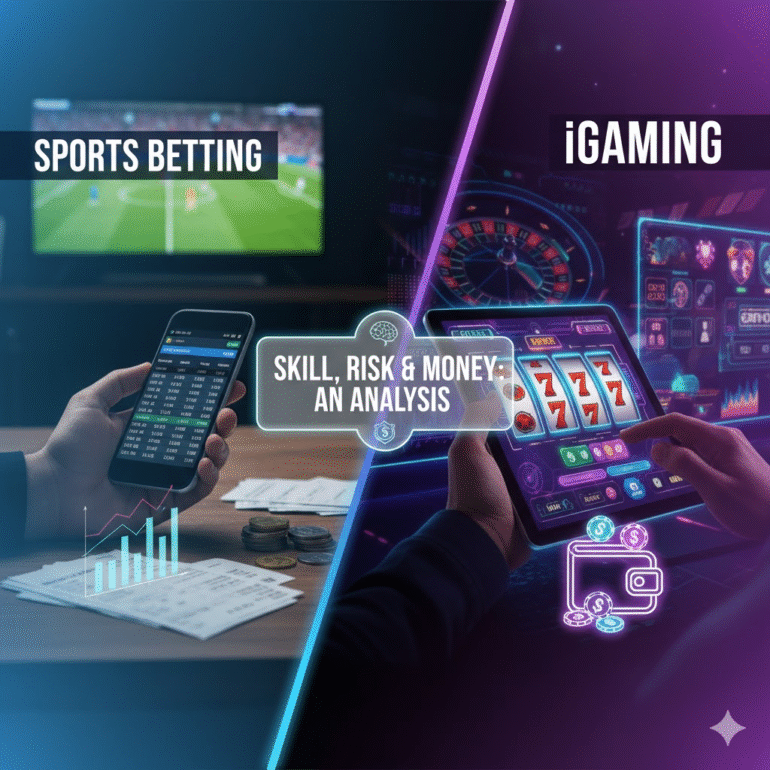
Sports Betting vs. iGaming: An Analysis of Skill, Risk, and Financial Models
todayNovember 14, 2025
Sports Betting vs. iGaming: An Analysis of Skill, Risk, and Financial Models
Image Credit – Gemini
Online gambling is a multi-billion-dollar industry that is dominated by two verticals, namely sports betting and online casinos (iGaming). There is still a long-standing myth that sports betting is a more acceptable, more skillful type of activity, a game of skill and analytics, in contrast to the chance of pure and passive gambling with a slot machine. However, can this distinction still be true in the era of high-speed mobile applications?
This paper gives an extensive comparative examination of sports betting and iGaming with reference to the four key areas that characterize them: player agency, financial models, user experience, and the contemporary dangers of addiction.
1. The Core Mechanic: Skill vs. Chance
The greatest justification for sports betting superiority is the role of the player. In sports betting, the gamer is a participant in the analysis process; in iGaming, they are the recipient of a random result.
Sports Betting: A Game of Skill and Analytics
Sports betting refers to the practice of making predictions about real-life sporting events. Its association with reality is its defining feature. The variable performance of the human athletes determines the outcomes.
This is not a simple guess. The industry is built on analytical wager types like:
Point Spreads: Betting on the margin of victory, not just the winner.
Totals (Over/Under): Betting on the total combined score.
Proposition Bets (“Props”): Betting on specific statistical events within a game.
Player agency is high. As a bettor, one can use in-depth knowledge, statistical models, and analytics to search for value, i.e., to think that the actual likelihood of an event happening is greater than the odds provided by the bookmaker. It resembles a financial market, in which participants go out to arbitrage overpriced assets.
iGaming (Online Casino): A Game of Algorithmic Fate
The term online casinos or iGaming is characterized by the lack of connection to the real world. In such games as online slots, roulette, and virtual baccarat, the result is decided purely by a Random Number Generator (RNG).
RNG is a computer algorithm that is capable of generating millions of random numbers every second. When one of the players clicks spin on a slot machine, the software captures the number generated within that microsecond and correlates it with an outcome on the reel.
The implications are profound:
Skill is Irrelevant: There is no way to create a strategy, a hot streak, or a belief that can affect the result of an RNG-based game.
Outcomes are Independent: Each spin is an independent event that is not related at all to the previous spin. The so-called gambler’s fallacy (concept of an outcome being due) is only a fallacy.
Whereas iGaming sites are verified as being fair (as the RNG is actually random), being fair does not imply that they will be won.
2. The Financial Model: Vigorish vs. House Edge
The most apparent distinction between the two verticals is their method of making money. This economic structure dictates a player’s long-term financial prospects.
iGaming and the “House Edge”
The online casinos use a house edge (or casino advantage). This is an in-built mathematical advantage that ensured the operator’s profit in the long run. It is done through structuring the payouts to be less than the actual statistical chances of winning.
Example (American Roulette): A roulette wheel has 38 pockets. The actual chance of striking a single figure is 37-to-1. The payout of the casino is 35-to-1, however. This gap creates a 5.26% house edge.
Example (Online Slots): Slots incorporate a Return to Player (RTP). A 94 percent RTP is equivalent to a 6 percent house edge.
The house edge is a mathematical law. It renders long-term profit to the player mathematically impossible. The sole strategy is mitigation of losses (e.g., playing a game with a 1 percent advantage over a game with a 10 percent advantage).
Sports Betting and the “Vigorish” (Vig)
Sportsbooks lack a house advantage. They instead take a commission on facilitating a wager. This commission is the so-called vigorish or vig.
The vig is built into the odds. The most frequent one is the -110 line on a point-spread bet.
Example (-110 odds): A bettor must wager $110 to win $100.
How the Book Profits: Suppose that Bettor A places a bet of 110 dollars on Team A and Bettor B places a bet of 110 dollars on Team B. The sports book has received $220. The victor receives compensation of $210 (his stake of $110 plus winnings of 100). The sportsbook retains the rest of the money in the form of commission.
This renders the sportsbook to be a market maker, as opposed to an actual competitor. The vig implies that a gambler needs to win 52.38 per cent of the amount -110 to break even. Although it is very hard, this model implies that a highly skilled bettor is theoretically able to win long-term profit.
The User Experience: Social vs. Solitary
Traditional sports betting has a longer engagement, in terms of entertainment per dollar. One bet of twenty dollars can offer three hours of increased entertainment as a person watches a game. The same 20 dollars in an online casino may be lost in a few minutes because the gaming is very fast.
This slow gambling cycle of traditional betting is also a harm reduction as a passive form. Psychologically, research indicates that sports betting is associated with an increased self-reported level of happiness, and in many cases, it is a social, communal activity. On the other hand, iGaming (in particular, slots) is more associated with the concept of detachment and playing alone, which are some of the risk factors of developing problem gambling.
4. The Great Convergence: The New Face of Addiction
The discussion up to this point confirms the assumption that sports betting is superior. But this assumption breaks down when its contemporary application is examined. The “betterness” of sports betting was tied to its slow nature. The modern online sports betting industry has systematically eliminated this safeguard. This is facilitated by the so-called in-play or live betting.
The same feature, which has become the main source of income for many operators, enables them to make continuous bets in a game with rapid firing. Bettors have the option to bet on granular events such as the one to win in the next play or the next player to score.
This innovation brings the essential addictive mechanic of the slot machine, speed, into sports betting. It converts the activity into a low-frequency, analytical endeavor into a high-frequency, dopamine-fueled loop of feedback.
The data confirms the consequences:
The problem gambling prevalence rates in sports bettors are at least two times higher than the general gambling rates.
A study of online sports gamblers identified 16% of them as meeting the clinical definition of gambling disorder, and 13% displaying indications of problematic play.
The introduction of online sportsbooks, not retail (in-person) ones, is the primary driver of new help-seeking for gambling addiction.
The Final Verdict: A Superior Product, A Dangerous Platform
Is sports betting superior to iGaming? The response to this is a complicated yes, but.
Sports betting has an essentially better product. It is a game of skill, agency, and intellectual engagement with a commission-based financial model that does not make long-term player loss a mathematical certainty.
But the service is now being offered on a 24/7 mobile application, and the functions that make it profitable (high-speed in-play bets) have enabled a delivery platform that is equally, or more, harmful than an online casino. The “betterness” of the core product is being nullified by the “worseness” of its high-velocity implementation.
By Hays Carlyon If the 2025 Jaguars season ends in total collapse, like the 2023 campaign, we will all easily be able to trace the moment where it began. Sunday, Nov. 8 in Houston right around 3 p.m. That’s roughly when the Texans mounted a 19-point comeback to beat the Jaguars 36-29. Make no mistake: this was one of the most stunning losses in franchise history. A chance to move […]
Parker Washington Might Be the Jaguars’ Most Important Breakout in 2026 Photo by Dave Adamson on Unsplash The Jaguars' window is open. After a 13-4 regular season, an AFC South title, and an eight-game heater to close out 2025, Jacksonville finally looks like the franchise people thought they'd become when […]
Do Record-Breaking NFL Contracts Actually Lead to Championships? Every offseason brings another round of numbers that top the last one. Quarterbacks sign deals worth $50 million per year. Edge rushers reach $30 million annually. Wide receivers clear the $25 million mark, with guaranteed money that would have covered whole rosters […]
todayJuly 8, 2026
Craig Larson Jr.
Craig Larson Jr. is a freelance contributor for 1010XL. Craig has been covering professional and collegiate sports for media outlets since 1990. He’s attended 17 Super Bowls, 11 Final Fours, 5 World Series, along with multiple Kentucky Derbies, Championship Fights and All-Star Games.